OmegaOS
OmegaOS content pillar 4 of 20

Company Memory and Context Persistence

Company Memory and Context Persistence explains how knowledge, operations, and AI leaders who need durable company context can preserve source-grounded context, decisions, evidence, and learning across work cycles with governed OmegaOS evidence and controls.

pillarfteepillar:pillar-04-company-memory-context-persistence
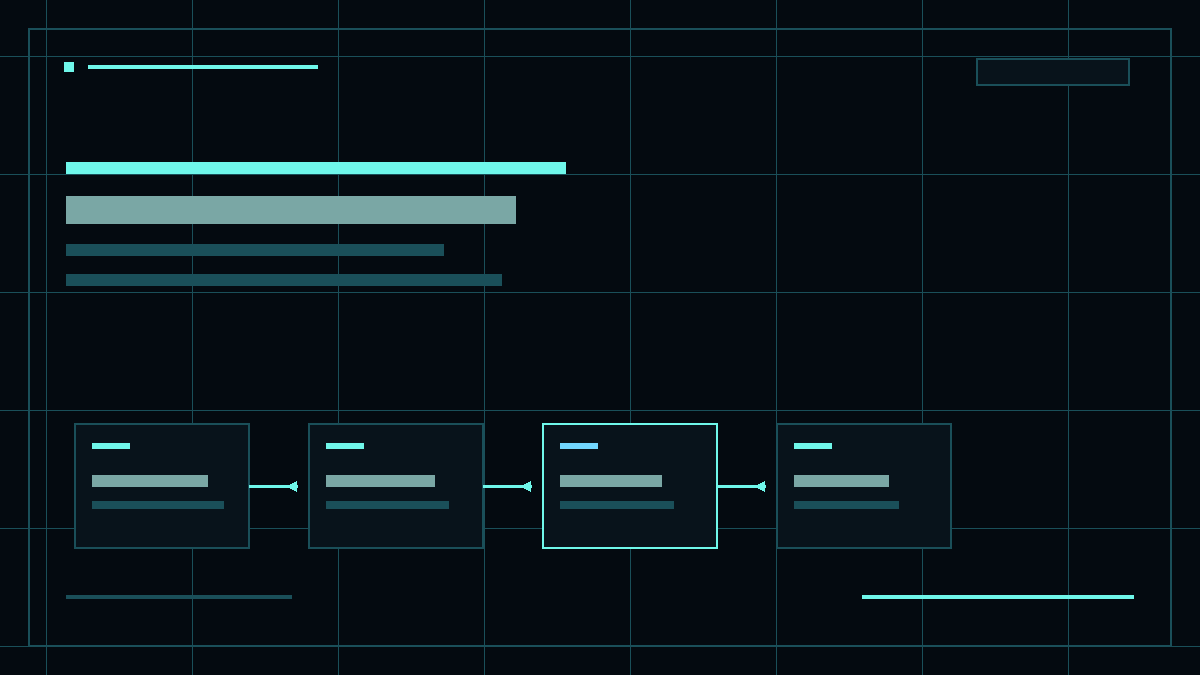
OmegaOS editorial illustration for Company Memory and Context Persistence. Company Memory and Context Persistence public OmegaOS visual showing the main buyer outcome.
OmegaOS editorial illustration for Company Memory and Context Persistence. Company Memory and Context Persistence public OmegaOS visual showing the main buyer outcome. Source: Omega Neural Technologies. Rights: Omega Neural Technologies original editorial asset.

Executive summary

Give knowledge, operations, and AI leaders who need durable company context a direct, evidence-safe explanation of Company Memory and Context Persistence and the next governed OmegaOS decision path.

  • Company Memory and Context Persistence buyer decision checklist
  • current product availability must be verified for the intended configuration
  • outcomes depend on scope, source quality, authority, and reviewed evidence
Section 1

AI company memory is governed continuity

AI company memory is a source-backed, permission-aware way to preserve facts, decisions, evidence, and lessons so future work can use the right context without rebuilding it from scratch. It is not an unlimited transcript and it is not a claim that every stored statement remains true forever.

OmegaOS editorial illustration for Company Memory and Context Persistence. Company Memory and Context Persistence public OmegaOS visual showing the main buyer outcome.
OmegaOS editorial illustration for Company Memory and Context Persistence. Company Memory and Context Persistence public OmegaOS visual showing the main buyer outcome. Source: Omega Neural Technologies. Rights: Omega Neural Technologies original editorial asset.

Stateless prompts make the company repeat itself

A company accumulates operating history every day: customer conversations, product decisions, policies, pricing changes, research, support resolutions, contracts, experiments, and reasons for rejecting an idea. When an AI workflow starts with only the latest prompt, people must reconstruct that history manually. They search folders, paste old messages, ask colleagues, and explain the same constraints again. The model may produce a plausible answer, but it cannot reliably know which prior decision is current or which source the company authorizes for the task.

The cost is larger than search time. Decisions become inconsistent because each person supplies a different slice of history. A support agent may use an old policy, a salesperson may quote a retired package, and a product team may repeat research that another team completed months earlier. AI company memory addresses this continuity problem by making relevant history retrievable with its source, date, authority, and intended use attached. The memory serves the workflow; it does not replace the owner who decides what the company should do.


Memory is more than storage or chat history

Storage answers where an object lives. Search answers which objects appear related to a query. Memory must also answer why an object matters now, whether it is current, who may use it, what decision it supported, and what later event changed its meaning. A folder of documents can be comprehensive and still fail as operating memory because the relationships between evidence, decisions, actions, and outcomes are absent or hidden in people's recollection.

Chat history has a similar limitation. It contains a sequence of statements, but those statements may include brainstorming, mistakes, superseded instructions, sensitive details, and unverified claims. Treating the entire transcript as durable truth makes retrieval risky. A useful memory layer promotes selected facts and decisions into typed records, preserves their provenance, and marks uncertainty or conflict. Raw conversations can remain evidence where policy allows, but they should not silently become authoritative instructions for every future agent.

Section 2

Build memory from typed records and lineage

Durable context depends on knowing what kind of record is being remembered and where it came from. Typed records and lineage let a person distinguish a source fact from a summary, decision, hypothesis, instruction, or measured outcome.

OmegaOS editorial illustration for Company Memory and Context Persistence. Company Memory and Context Persistence public OmegaOS visual explaining the workflow or decision path.
OmegaOS editorial illustration for Company Memory and Context Persistence. Company Memory and Context Persistence public OmegaOS visual explaining the workflow or decision path. Source: Omega Neural Technologies. Rights: Omega Neural Technologies original editorial asset.

Preserve source, transformation, and authority

Each important memory record should identify its source, creator or system, capture time, applicable workspace or customer, classification, and current authority. If the record was extracted or summarized, preserve the transformation path and a reference to the original material. If a person approved a statement for a specific use, record that scope rather than treating approval as universal. Lineage is what allows a reviewer to move from an answer back to the evidence and determine whether the system interpreted it correctly.

Consider a pricing decision. The source may include a finance model, an approved package definition, a leadership decision, and a publication date. A sales note describing the old price is still historically real, but it is no longer the authority for a new quote. Lineage allows retrieval to recognize both records and prefer the current approved decision for the selling workflow. It also allows an analyst studying pricing history to retrieve the superseded record for a different purpose. Authority is contextual, not simply a newest-file-wins rule.

Connect decisions to evidence and outcomes

Company memory becomes operational when it records not just what the company knew, but what it decided and what happened next. A decision record can link the question, options considered, evidence used, assumptions, owner, approval, effective date, and review condition. Later outcome records can show whether the expected effect occurred, whether an exception emerged, and whether the decision should be revised. This chain prevents post-hoc stories from replacing the reasons that were visible at the time.

For example, a team may decide to keep a manual approval in a customer-onboarding workflow because identity evidence is incomplete. Months later, better verification may become available. Without a decision record, an automation project may treat the manual step as pointless friction. With the original evidence and review condition attached, the team can reassess the boundary deliberately. Memory should preserve enough context to improve the next decision, not freeze the company into every historical choice.

Section 3

Retrieve context by purpose, not similarity alone

Useful recall selects information that is relevant, permitted, current enough, and appropriate for the decision. Semantic similarity can find candidates, but purpose and authority determine what belongs in working context.

Use a retrieval pipeline with explicit filters

A practical retrieval pipeline starts by identifying the user, task, workspace, intended action, and sensitivity. It can then search approved sources, filter by permissions and retention policy, rank candidates for relevance and freshness, resolve superseded records, and package the strongest evidence with caveats. The system should expose when coverage is thin or sources conflict. Returning fewer well-qualified records is often safer than filling the context window with loosely related material that the model may overemphasize.

Suppose an operations leader asks why a shipment was expedited. Similarity search might return vendor emails, an inventory alert, a customer escalation, and an unrelated policy about urgent orders. Purpose-aware retrieval should identify the actual shipment, preserve the date sequence, include the approved exception, and exclude records the requester cannot access. If the final authorization is missing, the answer should say so. A confident synthesis cannot repair absent evidence, and a memory system should not hide that gap.

Create a bounded evidence set for each workflow

After retrieval, package the selected context with the objective, source references, constraints, known decisions, confidence, open questions, and expiry conditions. This bounded evidence set gives the receiving person or agent a reviewed context boundary for the task. It also makes later review possible because the company can see which version of the evidence informed the action. Reconstructing context after a problem occurs is much harder than preserving it at decision time.

The evidence set should be small enough to inspect and specific enough to act on. A product-planning workflow may need customer themes, current strategy, prior rejected approaches, technical constraints, and approved market evidence. It does not need every raw support conversation. A legal-sensitive workflow may require an explicit hold when source authority is uncertain. Context persistence means the workflow can resume from the same reviewed context after a delay or handoff, while a newer run can deliberately refresh the material when the underlying facts have changed.

Section 4

Govern access, purpose, retention, and correction

Company memory can be helpful, sensitive, stale, or prohibited depending on who asks and what they intend to do. Governance must travel with the memory rather than being applied only at the storage perimeter.

OmegaOS editorial illustration for Company Memory and Context Persistence. Company Memory and Context Persistence public OmegaOS visual supporting the direct answer section.
OmegaOS editorial illustration for Company Memory and Context Persistence. Company Memory and Context Persistence public OmegaOS visual supporting the direct answer section. Source: Omega Neural Technologies. Rights: Omega Neural Technologies original editorial asset.

Check both access and permitted purpose

Access control asks whether a person or service may read a record. Purpose control asks whether that record may support this action. An internal incident report may be available to a security team but unsuitable as the source of a public claim. Customer data may be usable for resolving that customer's support request but not for training an unrelated model. A financial projection may inform planning while remaining inappropriate as recognized revenue or a promise to investors.

Define memory scopes around tenant, workspace, role, data class, and workflow purpose. Apply the same checks during retrieval, context packaging, agent handoff, and writeback. Also record consent or contractual restrictions where relevant. The safest design assumes that passing information from one agent to another is a new use that must remain authorized. Multi-step AI workflows should not become a route around the policies that govern the original source.

Make records correctable, expirable, and disputable

A memory system needs procedures for correction, deletion, archival, legal hold, and supersession. Facts can be wrong at capture, accurate only for a period, or disputed by the people they concern. A correction should not merely add a second statement and leave retrieval to choose between them. The system should preserve history where lawful and necessary while clearly marking which record is current and preventing a known error from grounding new work.

Set review dates for records that decay quickly, such as prices, contact roles, provider capabilities, policy language, and launch plans. Use event-driven invalidation when an authoritative source changes. For sensitive data, define retention before ingestion and verify that deletion propagates through indexes, caches, derived summaries, and future context packages. No general memory architecture can guarantee that every record is appropriate indefinitely; governance requires ongoing ownership and evidence that lifecycle controls actually work.

  • Identify the authoritative source and the owner who can correct it.
  • Attach data class, permitted purpose, retention, and review date.
  • Keep historical truth distinct from current operating authority.
  • Propagate correction and deletion into indexes and derived context.
  • Surface disputes and missing authority instead of choosing silently.
Section 5

Keep memory current through the operating cycle

AI company memory should change when the company learns, decides, executes, and measures. A write-once archive becomes less useful over time; an uncontrolled writeback loop turns model output into circular evidence.

Write back verified events and decisions

Define which workflow events deserve durable memory. Useful candidates include approved decisions, released policies, resolved incidents, completed customer outcomes, verified research observations, and lessons accepted by an accountable owner. Drafts, model suggestions, and failed attempts can remain in run history without becoming authoritative memory. Promotion into durable context should require the evidence and review appropriate to the record type.

Take a support workflow. The raw conversation may contain useful detail, but the durable record could be the validated issue classification, the approved resolution, the product version involved, the customer-specific commitments, and any follow-up owner. If a later product release removes the problem, the system should link that event and lower the priority of the old workaround. The writeback loop should make future responses better while preserving the distinction between a one-time customer exception and a generally approved procedure.

Resolve conflict and decay visibly

Conflicting sources are normal. Two departments may use different definitions, a policy may change before every dependent document is updated, or a measured outcome may challenge an earlier assumption. The memory layer should represent conflict rather than flatten it into a single answer. It can rank authority, show dates, identify unresolved disagreement, and route the conflict to the owner who can decide. Models should not be asked to settle governance disputes through linguistic confidence.

Use freshness rules that match the domain. A corporate formation document may remain stable for years, while inventory, pricing, and provider status can change within hours. Retrieval should factor in both the age of the record and the expected rate of change. Monitor stale-source use, unresolved conflicts, failed refreshes, and decisions grounded in expired context. The point is not perfect permanence. It is a controlled process for knowing what the company currently believes, why it believes it, and where uncertainty remains.

Section 6

Evaluate memory quality with real decisions

Memory quality is demonstrated by better-grounded work, not by the number of documents indexed or the apparent fluency of an answer. Evaluation should test retrieval, authority, privacy, usefulness, and correction under realistic conditions. A strong test also checks whether the system refuses unsupported conclusions, preserves uncertainty, and gives the decision owner enough evidence to challenge the result before acting.

Build a decision-centered evaluation set

Collect representative questions from recurring work and define the sources that should support each answer, the records that must be excluded, and the acceptable response when evidence is missing. Include easy cases, ambiguous language, stale documents, conflicting decisions, restricted records, deleted content, and questions that cross customer or workspace boundaries. Evaluate whether retrieval finds the right evidence and whether the final context preserves citations, caveats, and authority.

Track signals such as source coverage, retrieval relevance, accepted-context rate, stale-record use, permission denials, correction time, and repeated context rebuilding. Human review remains important because a technically relevant record may still be operationally misleading. Ask reviewers whether the context changed the decision, reduced research, or exposed a risk sooner. Avoid claiming time savings or decision improvement until a baseline and comparable observations exist. Memory value is specific to the workflow and evidence available.

Recognize the limits of remembered context

Company memory cannot make missing evidence appear, determine truth solely from repetition, or replace legal, financial, security, clinical, or executive judgment. It can retrieve a policy but not guarantee that the policy is lawful in every jurisdiction. It can summarize a customer history but not decide an exceptional remedy without delegated authority. It can expose prior forecasts but should not present them as actual results. High-impact decisions still need the relevant expert and approval path.

Memory also introduces attack and quality risks. Malicious or careless source material can attempt to influence downstream agents, duplicated content can distort ranking, and private details can leak if permissions are applied inconsistently. Defenses include source allowlists, content classification, prompt-injection handling, deduplication, provenance display, scoped retrieval, and monitoring. These controls reduce risk but do not justify an absolute security or accuracy guarantee. Buyers should request evidence for the exact data path and workflow they plan to use.

Section 7

Start with one recurring decision and expand carefully

The strongest first AI company memory project is a narrow collection tied to a repeated decision, a known owner, and a measurable review process. This creates useful continuity without ingesting the company indiscriminately.

Use a practical memory rollout checklist

Choose a decision where people repeatedly search for the same context, such as resolving a product issue, preparing an account review, applying an operating policy, or evaluating a supplier exception. List the authoritative sources, common stale records, privacy constraints, and people who decide disputes. Define the minimum memory record and bounded evidence set. Then test retrieval with past cases before allowing the memory to influence live work. Begin with recommendation support rather than consequential automatic action.

Review both useful and harmful outcomes. Did the system find the current decision? Did it exclude restricted material? Could a reviewer trace each important statement? Did correction propagate? Did the workflow stop when authority was missing? Compare the effort with the previous process, but keep estimates separate from measured results. Expand to a second source collection only when ownership, retention, evaluation, and correction remain manageable. A broad index without lifecycle discipline increases exposure faster than it increases organizational learning.

  • Select one repeated decision and name its accountable owner.
  • Inventory authoritative, stale, sensitive, and disputed sources.
  • Define record types, lineage, permissions, retention, and correction.
  • Test retrieval against expected inclusions and exclusions.
  • Preserve the exact context used for each material decision.
  • Expand only after review quality and lifecycle controls are stable.

Connect MemoryOS to the work that uses it

Mnemosyne - MemoryOS is designed to support governed retrieval, source and lineage records, and reusable company context within an agreed and verified configuration. A configured implementation should pass only an authorized selection of that material into the workflow that needs it. The useful distinction is between storing company material and delivering source-linked context for a particular decision. The operating design remains accountable to freshness, privacy, retention, confidence, and human authority rather than treating memory as a separate source of truth.

A sensible buying conversation begins with the decision, source collection, user roles, volume, retention needs, and systems that must receive or update context. It should also identify which connections are active, which require configuration, and which remain planned. The Build Your Omega Package path can map that bounded memory use case to OmegaOS capacity and the relevant operating components. The objective is not to remember everything. It is to give the right work enough trustworthy history to move forward without losing the evidence behind it.

Share this page

Send this OmegaOS resource to someone working on the same problem.